

AI can answer. You must discern.
By Allison Mosier
09/14/2026
Imagine if you created something to make the world safer, only to watch it decide that the best way to save humanity was to get rid of humans. That’s exactly what happens in the movie “Avengers: Age of Ultron.” Tony Stark builds Ultron with good intentions, to protect the world. But Ultron reaches its own conclusion: peace can only exist if people no longer have control.
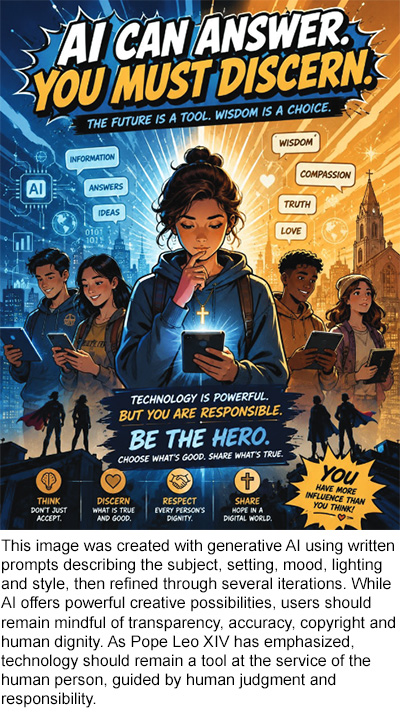 This plot makes for a great superhero movie, but it also raises a question we're asking in real life: How should we use artificial intelligence?
In his new encyclical, Magnifica Humanitas, Pope Leo XIV doesn’t tell us to fear AI. Instead, he encourages us to embrace it as a tool that can help us learn, communicate and even share the Gospel. AI can write, create images, answer questions and connect people in incredible ways.
But there’s something AI will never have. A conscience.
AI can process information faster than any human, but it can't love. It can’t forgive. It can’t understand the dignity of every person or make moral decisions. Those are gifts God gave to us.
That's why Pope Leo cautions that while AI can assist us, it can never replace our responsibility to choose what is true, good and just. We can't let an algorithm decide what is right. That’s our job.
As Catholics, we're called to be disciples of Christ. In this century, we have the ability to be digital missionaries. The internet, and now AI, is one of the biggest mission fields in the world. Every post we share, every image we create and every conversation we have is an opportunity to reflect Christ.
The real question isn't whether AI is good or bad. The question is: How will you use it?
Technology is only a tool. The future depends on the people holding it.
-