

Pope Leo XIV’s First Encyclical Offers a Guide for Humanity in the Age of Artificial Intelligence
By Allison Mosier06/03/2026
As artificial intelligence continues to shape communication, education, work and everyday life, Pope Leo XIV’s first encyclical, Magnifica Humanitas (“Magnificent Humanity”), offers the Church and the world a timely reflection on the dignity of the human person in an increasingly digital age.
The Pope signed the encyclical on May 15, the 135th anniversary of the promulgation of Pope Leo XIII’s Rerum Novarum, often considered the foundational text that addressed the harsh conditions of the Industrial Revolution. The Magnifica Humanitas draws a parallel to the age of artificial intelligence, examining both the promise and the challenges of AI, encouraging people to approach emerging technologies with wisdom, responsibility and faith. Rather than rejecting technological advancement, Pope Leo XIV calls for discernment — reminding the faithful that innovation must always remain rooted in the common good and respect for human dignity. The document was released on May 25.
Bishop Lawrence T. Persico said the encyclical arrives at an important moment for society and for the Church.
“Technology is advancing rapidly, and many people are asking how to navigate these changes faithfully and responsibly,” Bishop Persico said. “Pope Leo XIV reminds us that the human person can never be reduced to data, productivity or efficiency. Every person is created in the image of God and deserves to be treated with dignity, compassion and respect.”
Throughout the document, Pope Leo XIV acknowledges both the benefits and concerns surrounding artificial intelligence, including its potential impact on employment, communication, truth and human relationships. He warns against allowing society to prioritize optimization and efficiency at the expense of authentic human connection.
The Holy Father writes that human weakness, suffering and vulnerability should not simply be viewed as problems to eliminate, but experiences through which people often encounter wisdom, love and God’s presence.
For diocesan communications leaders, educators and ministry professionals, the encyclical also offers practical guidance for how the Church can engage the digital world thoughtfully and responsibly.
Kristine Rilling, executive director of communications and advancement for the Diocese of Erie, said the document provides valuable direction for Catholic communicators seeking to evangelize in today’s fast-moving media landscape.
“Artificial intelligence can be an incredibly helpful tool for communication and outreach when it is used ethically and transparently,” Rilling said. “It can help ministries share information more efficiently, expand accessibility and reach people who may otherwise never encounter the message of the Gospel. At the same time, the encyclical reminds us that technology should never replace authentic human relationships, truth or discernment.”
Rilling noted that Catholic communicators face both opportunities and challenges as AI becomes more integrated into daily work.
“There are clear advantages, including helping small teams manage growing communication demands, improving translations and increasing access to educational resources,” she said. “But there are also serious concerns involving misinformation, manipulation, privacy and the temptation to value speed over truth and human connection. The Church has an important role in helping people navigate those questions responsibly.”
“The encyclical has to do with war and poverty. It has to do with the workforce and the ethical engagement of that workforce. It has to do with information and how we propagate information,” said Rev. Michael Kesicki, Chaplain, Gannon University and Pastor of St. Lawrence the Martyr Parish in Albion and the church of St. Philip in Crossingville. “Pope Leo lays out moral principals as he would do as a universal pastor to say that whatever we use in technology must always be used for the proper development of the human person and human society.”
The encyclical repeatedly emphasizes that technology itself is not inherently good or bad, but depends on how it is developed and used. Pope Leo XIV encourages society to avoid what he describes as the “Babel syndrome” — a culture focused on power, uniformity and self-sufficiency without God. Instead, he points to the biblical example of rebuilding Jerusalem together through shared responsibility, dialogue and communion.
Bishop Persico said that message is especially important for Catholics today.
“The Church is not called to fear the future,” Bishop Persico said. “We are called to enter it with wisdom, faith and a commitment to protecting the dignity of every human person. Pope Leo XIV’s encyclical is ultimately a message of hope — reminding us that even in times of rapid change, Christ remains at the center of what it means to be truly human.”
Resources
United States Conference of Catholic Bishops (USCCB)
The USCCB has assembled a collection of resources to help Catholics better understand Magnifica Humanitas, including the full text of the encyclical, Archbishop Paul Coakley’s statement welcoming the document, articles exploring its themes and additional commentary on the ethical challenges and opportunities presented by artificial intelligence.
USCCB Magnifica Humanitas Resources
Holy See / Vatican
The Vatican's Dicastery for Promoting Integral Human Development offers official resources related to Magnifica Humanitas, including the full text of the encyclical, summaries, background materials and additional reflections on safeguarding human dignity in the age of artificial intelligence.
Holy See Resources on Magnifica Humanitas
Read the Full Encyclical
Magnifica Humanitas (Official Text)
Inforgraphics:
CHAPTER ONE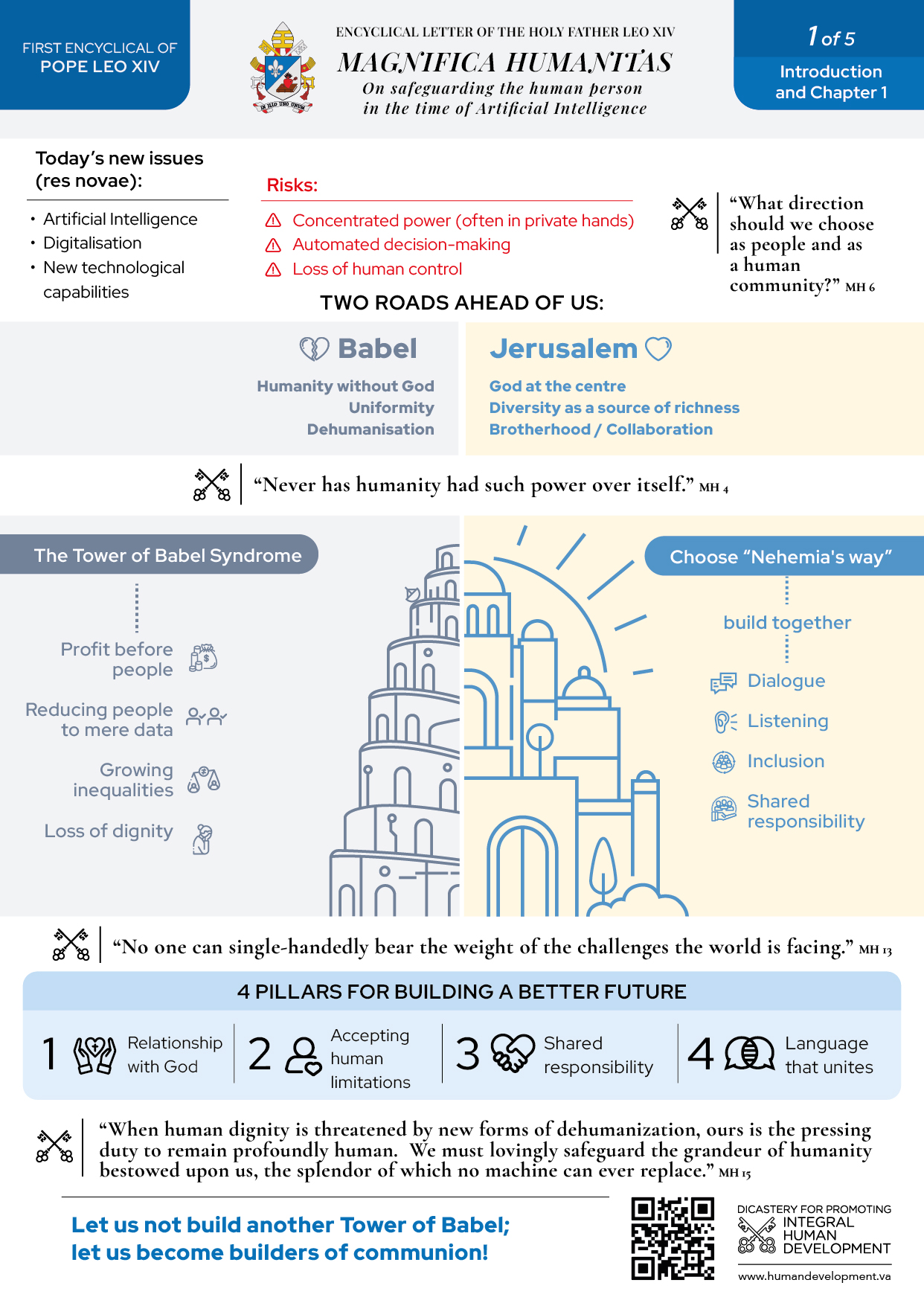
CHAPTER TWO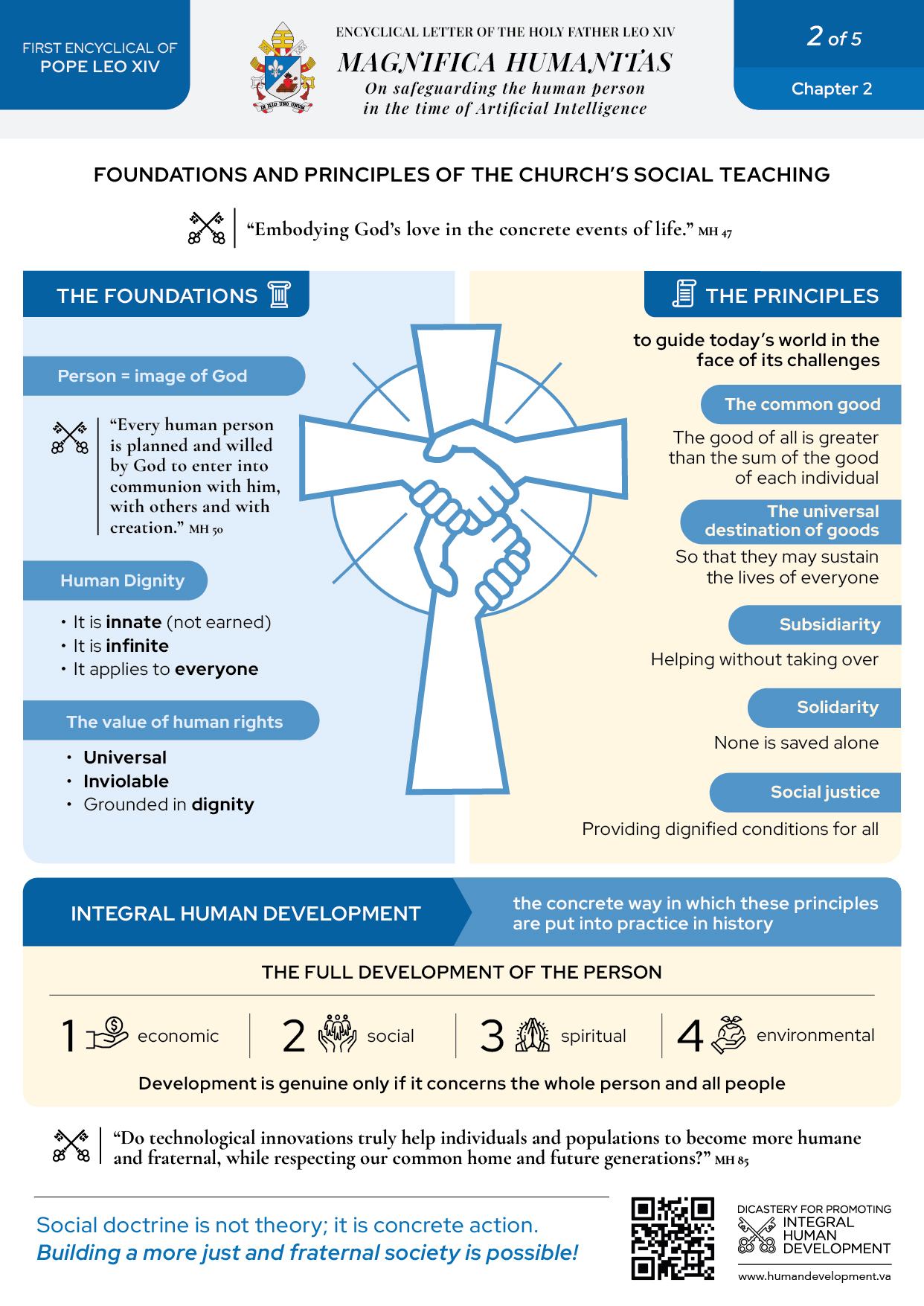
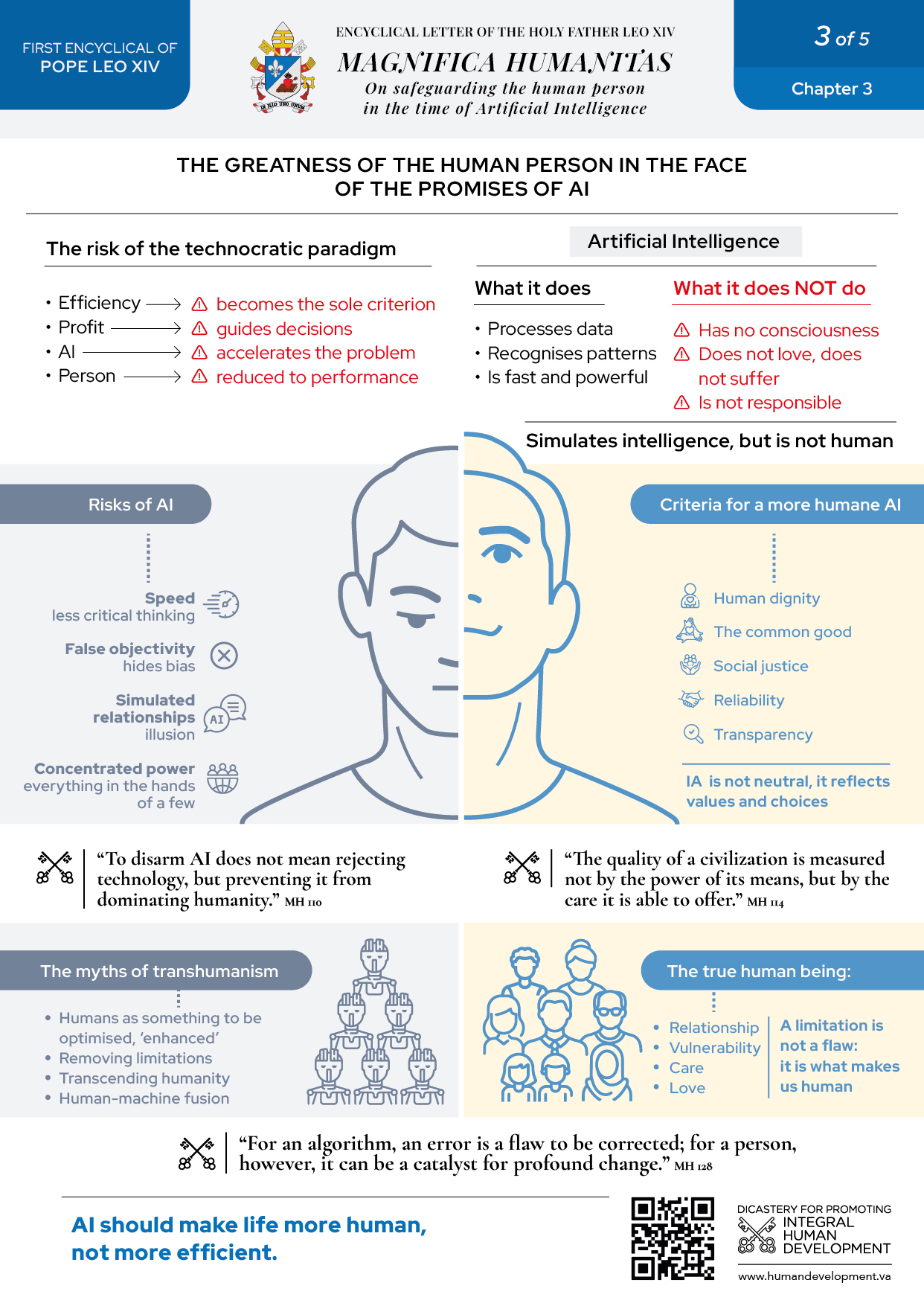
CHAPTER THREE
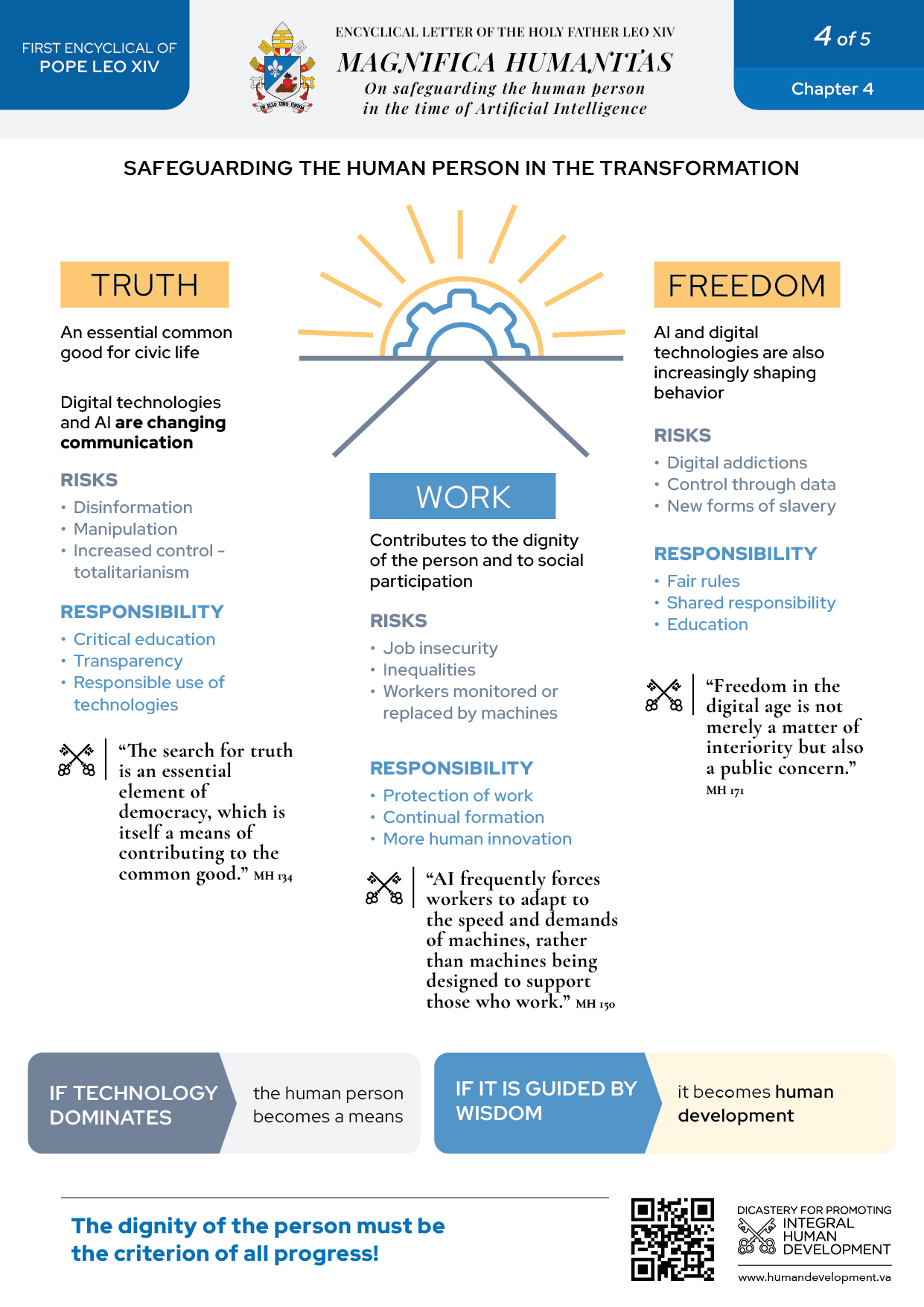
CHAPTER FOUR:
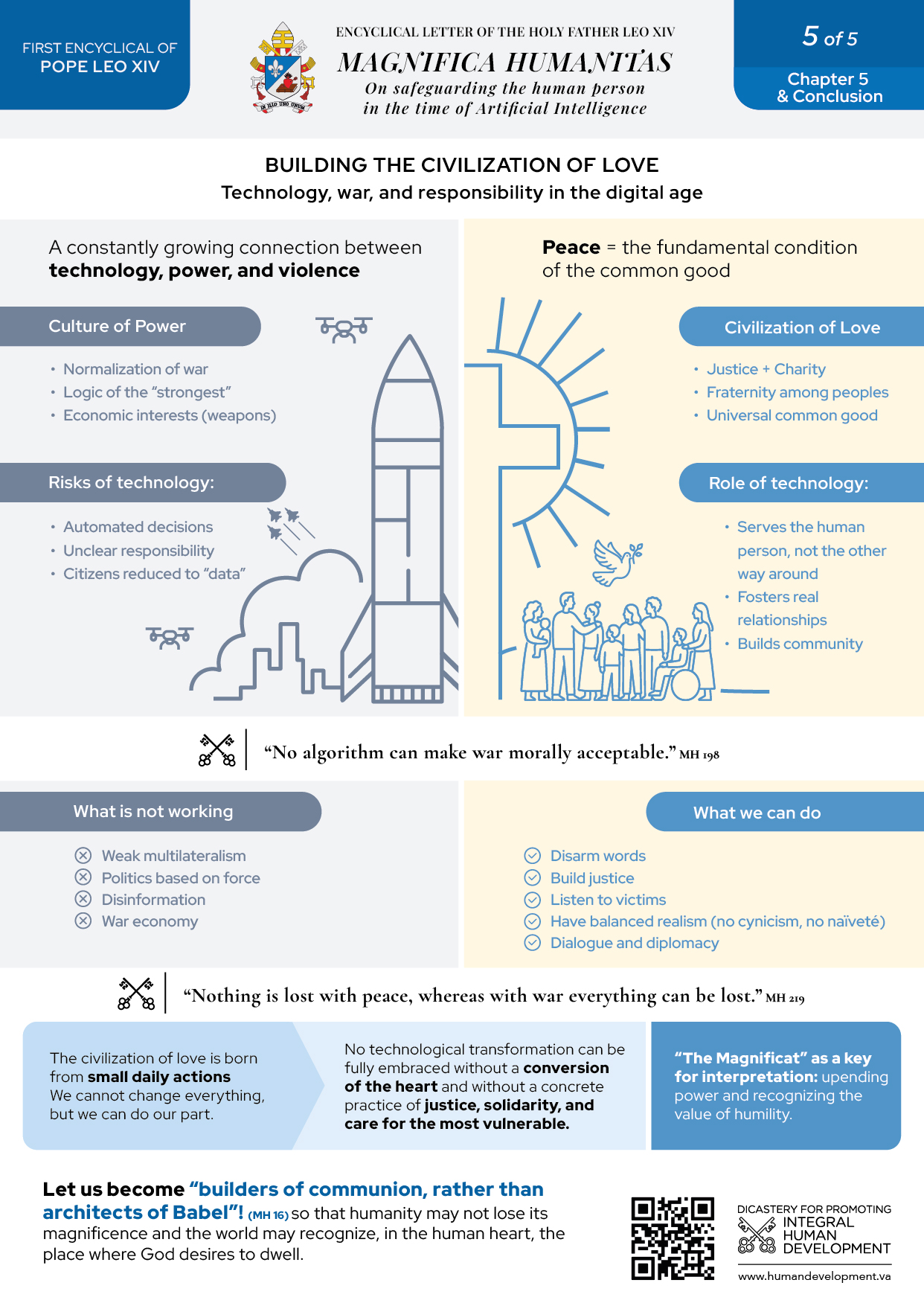
CHAPTER FIVE:
-