
Reflections at 75
11/20/2025
Reaching his 75th birthday, Erie Bishop Lawrence T. Persico paused with Faith magazine to look back on the journey of his episcopacy. He spoke candidly about the joys and trials of leadership, and the enduring grace of God at work in his ministry. More than just a conversation, the article stands as a testament to a life of faithful service, spiritual guidance and a legacy that continues to shape the Diocese of Erie and inspire those who follow.
Q: When you accepted the Holy Father’s call to serve as Bishop of Erie, you couldn’t have imagined the journey ahead. As you look back on your ministry, what stands out the most?
Bishop Persico: Over the years, the Diocese of Erie has experienced many graces, along with our share of challenges. For me, the most essential part was being present in the parishes. Visiting the parishioners — where they live and work — is necessary. It was in those experiences where I felt the most joy. I was with the people. We might have been celebrating an anniversary Mass, a jubilee or a confirmation. It didn’t quite matter what the occurrence was, but that I was engaging with the faithful of the diocese. That’s what it means to be a pastor.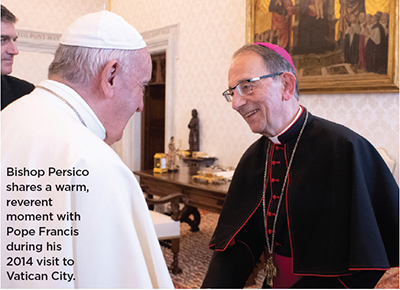 Q: You arrived with one agenda: to proclaim Jesus Christ and help people grow in their relationship with him. Has that remained central?
Bishop Persico: At the heart of every Christian is a desire to grow in faith. But our journey isn’t just about personal growth — it’s also about sharing that faith with others. We must remember that everything we do is a form of evangelization and should be something we continue to improve upon.
Q: How have significant moments in the life of the Catholic Church – both locally and throughout the world – shaped your ministry?
Bishop Persico: My ministry has been shaped not just by moments, but by the people I’ve encountered. I was blessed with a strong presbyterate — a dedicated, hardworking and collaborative group of priests. And our parishioners, too, made a strong impression. I felt at home right away because they were just like the people I grew up with in southwestern Pennsylvania: hardworking, committed, proud of their parishes.
Q: But the challenges were immense: pastoral planning, the grand jury investigation and then COVID.
Bishop Persico: Trying to listen to victims, keep clergy together and navigate government scrutiny — that was a tough journey. Then we moved right into the COVID-19 pandemic. In all of it, the relief was being in the parishes and with the people. It makes a difference when you show that you’re not denying or ignoring the truth. And I believe we’re in a healthier place now than we were before pastoral planning. The process was difficult — it disrupted lives and posed real challenges, not only for parishioners but for the clergy as well. Still, it has brought us to a stronger, more sustainable place, better prepared for the future. At the same time, we must remain steadfast in our prayer for vocations, as that need continues.
Q: Transparency became a hallmark of your leadership. Why?
Bishop Persico: It’s my nature. When you give the perception you’re hiding things, you set up mistrust. That’s why transparency is vital. After the grand jury, we had to let people know what was going on. That doesn’t mean divulging confidential details, but you do have to explain what you’re doing and why. When SNAP (Survivors Network of those Abused by Priests) arrived at St. Mark Catholic Center, I went out to greet them. One woman said I was the first bishop she had ever spoken to in 20 years. For me, it was just natural: you acknowledge people, especially when they are hurting.
Q: You were also the only Pennsylvania bishop to testify before the grand jury. Why did you do it?
Bishop Persico: I thought it would be good for the jury to see that someone was willing to talk. It wasn’t easy. But I wanted to share the steps we were taking — like our new policies — and to show the people that we were taking the situation seriously.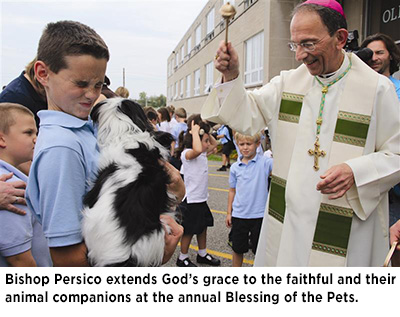 Q: You’ve been part of several gatherings that connected you to the wider church. One of them was the World Meeting of Families. Can you reflect on that experience?
Bishop Persico: It was a wonderful, exciting event with Pope Francis in Philadelphia. It had been years since we had a gathering like that focused so directly on families and the importance of family life. It was an uplifting experience, with tremendous enthusiasm among the people.
Q: You’ve met Pope Francis more than once – in Rome at what is sometimes called “new bishop’s school,” and during the 2019 ad limina visit. What did these moments mean to you?
Bishop Persico: In earlier years, Pope St. John Paul II often invited bishops for lunch. He would break them into smaller groups, and there would be table talk along with some formal remarks. With Pope Francis, it was different. We didn’t share a meal, but the experience was very personal. It wasn’t a lecture; it was a genuine exchange. That encounter, that openness to conversation, really underscored his style of leadership — listening, engaging and inviting us into a true pastoral dialogue.
Q: Can you share your thoughts on the National Eucharistic Revival?
Bishop Persico: The Eucharist is central to our faith, and it’s a devotion. We need to embrace Eucharistic revival. It caught fire at the national gathering in Indianapolis last summer, and I want it to close our Jubilee and lead us into our 175th anniversary in 2027. Eucharistic adoration will carry profound meaning for our journey ahead.
Q: As you prepare to retire, do you think about your successor?
Bishop Persico: No. That’s the work of the Holy Spirit. The qualities needed for the Diocese of Erie will be decided by the Holy Spirit for what the diocese needs at the time. I’m not worried about who it will be. Just as with the election of a pope, the Holy Spirit provides.  Q: Your motto has been Veritas in Caritate — Truth in Charity. Has it sustained you?
Bishop Persico: Yes. Truth can be very difficult, but how you present it makes all the difference. You have to speak the truth in love. That’s been my guide — and I’ve had to speak the truth more often than I ever expected.
Q: Finally, as you look back, what gives you peace?
Bishop Persico: That I did my best as pastor of this diocese. The diocese isn’t mine; it belongs to God. I am its caretaker for a time. It’s in his hands and in the hands of the Holy Spirit who will guide the next bishop. My task is to walk with the people here in faith, through joys and sorrows. And for that, I am grateful.
As Bishop Persico turns 75— the age bishops are required to submit their resignation to the Holy Father—we are invited to pray for a new bishop.
-